
Compare how AI models speak about your brand versus competitors
Identify strengths, weaknesses, and untapped opportunities across products, markets, and geographies. See how you rank against the players that matter in your market.
The goal is to gather the insights needed to answer the following questions:
- Who is mentioned most often — my brand or my competitors? Which brand tends to be favored in responses across different prompts?
- How is my brand positioned compared to each competitor? How do AI models perceive it?
- Where are the gaps? Which prompts mention my competitors but not me? Which pieces of competitor content are cited instead of mine?
Understanding your brand visibility score
Your brand visibility score = Percentage of prompts where your brand was mentioned by AI models. In other words, your brand visibility score represents how often your brand appears in the responses generated by the different models : ChatGpt, Claude, Perplexity, Gemini, Mistral. A strong scores means
- Your brand gets more visibility in AI responses.
- Users are more likely to see your brand first.
- You have a competitive edge over other brands.
Comparing your visibility to Competitors
Compare your visibility score directly against selected competitors to understand your relative market position. Higher scores indicate stronger AI search presence and better organic brand discovery. With GetMint you can:- Compare scores directly: find out how your visibility ranks against your competitors on each of your topics.
- Compare your scores across each model: deepen the analysis of your visibility score on every model to fine-tune and optimize your strategy.
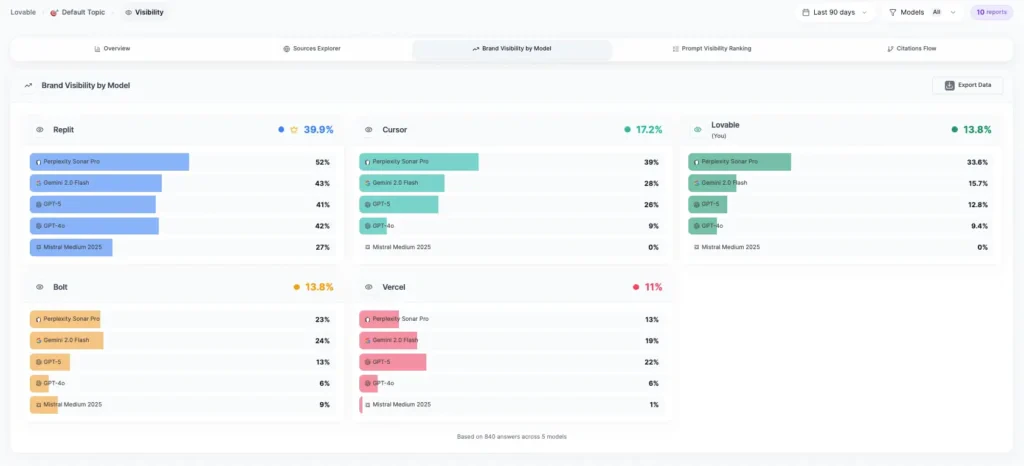
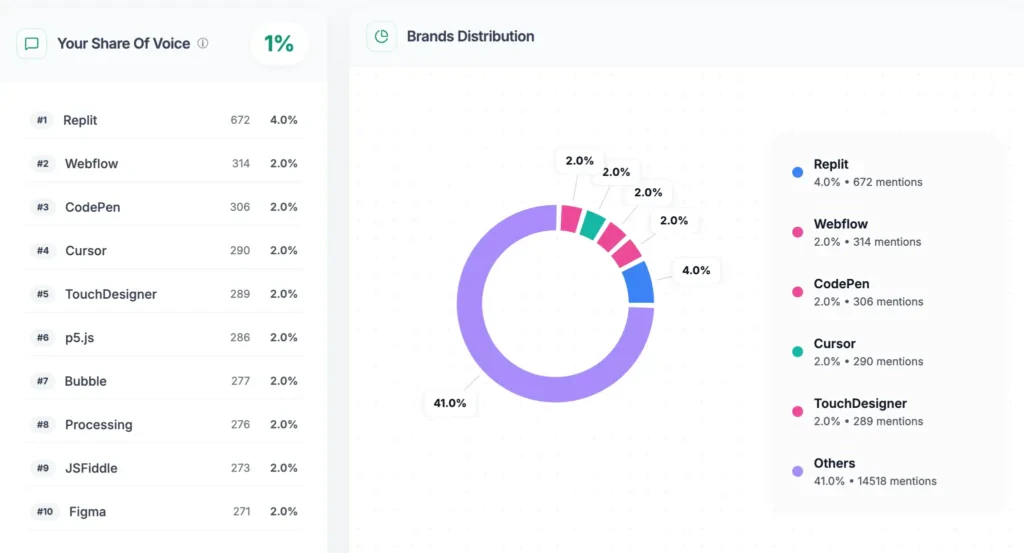
- Analyze your share of voice to understand how often your brand is mentioned in LLM responses compared to other players in your industry. This score shows your brand’s share relative to all brand mentions.
- Analyze the domains and URLs most frequently referenced by LLMs when generating their answers. This will help you identify which competitors’ content is perceived as authoritative and adjust your own content strategy so that your pages become sources cited by LLMs as well.
- Track trends over time: identify who is gaining market share in AI responses week after week.
\
Benchmark against Competitors The competition analysis tool compares your brand against direct competitors you’ve selected in project settings. For example, when analyzing Lovable versus Bolt across four different AI models, the system reveals:- Main strengths displayed to potential customers
- Key weaknesses compared to competitors
- User decision-making factors between brands
- Competitive positioning insights
\
Building a GEO Strategy Around Competition Now that you have identified your position relative to your competitors, the next step is to take action :- If some of your contents are already cited: add depth and up-to-date information to further strengthen AI confidence.
- Target prompts where you have gaps: publish optimized articles to regain market share in queries they currently dominate.
- Use the benchmark to create content specifically designed to enhance how AI models perceive your brand relative to each of your competitors (for example: comparison tools).